»sinusoidal run rhythm« emerges through the addition of in-phase cosine functions in integer frequency ratios. Compared to corresponding notated rhythms, their maxima are shifted in time and dynamics and exhibit a corporeality that is not present in discretely controlled rhythms. »sinusoidal run rhythm« models microtemporal grids with dynamic weightings that are singular for each underlying combination of frequencies. »sinusoidal run rhythm« thus defines rhythm as a wave and thereby clearly departs from the conventional rhythm theory of a European musical tradition. »sinusoidal run rhythm« is explicitly a complement, a specification, and an extension of already existing rhythm models and rhythm theories, and it can integrate them.
A book, code, and Max for Live (M4L) plugins were published in 2023 by Wolke Verlag.
Book: Wolke Verlag (2023) · Code: Repository (2023) · Plugins: M4L (2023) · Tryout (Web app)
In 2026, the dissertation of the same title was published by Wolke Verlag as an Open Access eBook .
TRYOUT
INTRODUCTION
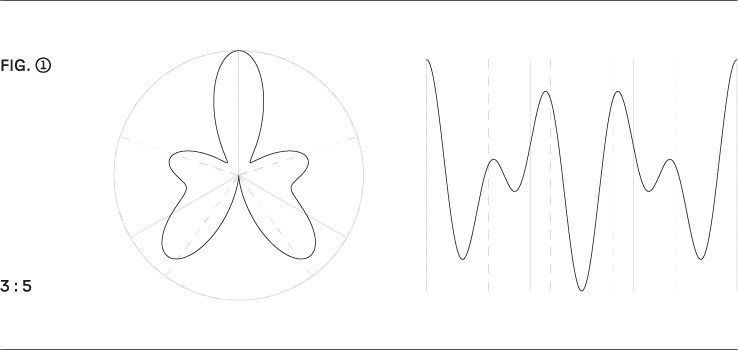
At approximately 16 events per second, humans have an auditory and visual threshold between distinguishable individual events and the perception of flow. Visually, this threshold is the transition from single images to the continuous flow of a film, and auditorily it is the transition from rhythm to frequency. This transition is fraught with conceptual fuzziness. If, for example, one slows down a flute tone to a frequency that is heard as rhythm, one can only see the rhythm as a membrane movement of the loudspeaker and no longer hear the tone. Conversely, the special characteristics of an accelerated rhythm’s waveform result in timbre. These inaudible rhythms can become audible by using them as amplitude envelopes – as low frequency oscillators (LFO) often used in electronic music. If one adds up in-phase cosine functions in integer ratios – which are pure intervals in the audible range – these also entail special characteristics in the form of rhythms: they are temporally shifted in their maxima compared to corresponding notated, discrete rhythms, and are thereby something fundamentally different from polyrhythms in the same ratio a:b (→ Fig. 1). In addition, the rhythms have volume weightings between their maxima. ¹
This is interesting and relevant for music because the interplay of the deviations in time and volume feature a physicality that is not present in discretely controlled rhythms. In literature, depending on the milieu and context, this phenomenon is commonly referred to as groove, timing, agogic, phrasing, or interpretation – to name just a few terms. They are the flipside of a European written tradition whose theory of rhythm discriminates between an ideal, discrete, objective realm – how rhythm is (written) – and an individual, subjective, interpretive realm of how it actually appears in the world. This subobjective view also splits into an internal, subjective perception or conception of a rhythm and its external appearance or performance. The phenomenon of sinusoidal run rhythms can liberate the notion of rhythm from this dualism of objective-theoretical and subjective-individual-physical. It reveals a concept of rhythm as an „intra-action“² in human, instrument, computer, in the entanglement of imagined and sounding vibration.
»sinusoidal run rhythm« proposes a definition of rhythm as a wave. It does not conceive of time in discrete subdivisions, but rather makes it continuously quantifiable. Through the aesthetics of wave additions, it introduces physicality not as a merely subjective concept, thus liberating it from mystification.
Traditional European rhythmic theory thinks in terms of allegorical weight, i.e., heavy and light time. Because of the attractive proximity to physicality and dance, the terms gravity and also gravitational wave remain in the orbit of the sinusoidal run rhythm, though the allegory aims at cycles of time whose rotation is subject to varying degrees of attention. Less allegorically represented, it is about an attention-time bent by waves. Or: in the entanglement of felt and quantified time, rhythm becomes graspable as a stretching of attentional time. Such a theory is not to be understood in purely linguistic terms, but also aurally, informatically and visually. It entangles the areas of analysis, genesis, and interpretation, and offers significant possibilities in collaboration with the disciplines of music theory, musicology, interpretation, composition, computer music, and sound art:
1
Models of rhythmic gravity on both sides of the beat, which in many cases give more convincing explanations and applications than a discrete view. Especially in terms of what rhythmically belongs (is joined) together, they open up a more intuitive understanding than the discrete division of the European tradition of notation. The product of the curve value and the energy value of a sound file results in a curve, whose integral can be used to calculate the center of gravity of the respective beat or wave crest. This is most clearly illustrated in polar notation by imagining the area of the integral as a disk to be balanced. This is a promising approach with diverse applications for music theory analysis as well as for psychoacoustics.
2
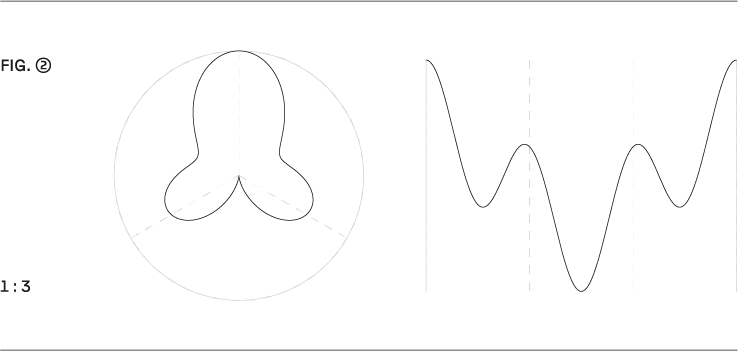
Fitting models for common so-called “interpretation” of rhythm. A simple example is the phrasing of a waltz, which can be modeled with the ratio 1:3 (→ Fig. 2) and resulting deviations.
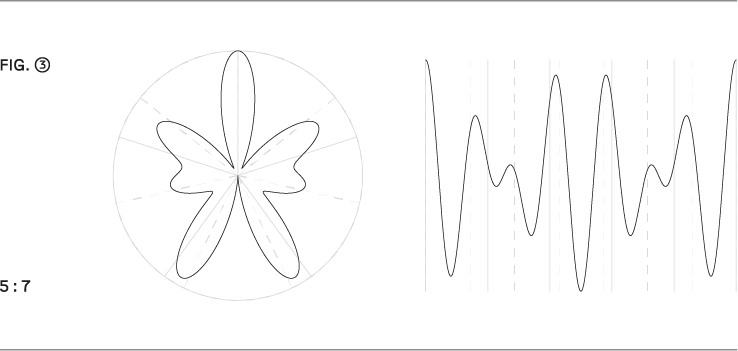
Such time deviations generated from rhythmic gravity are also applicable and intuitively comprehensible in more complicated ratios, for example at 5:7 (→ Fig. 3), which could be a model of a sub-Saharan clave with twelve subdivisions.
3
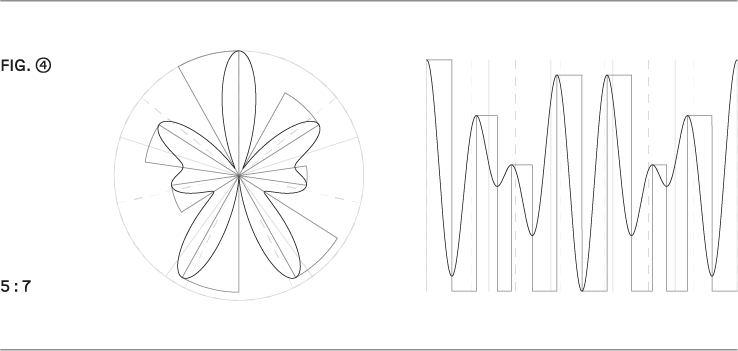
The genesis of music and sound art offers numerous fields of application. The appeal and relevance lie in the physicality of a non-discrete division of time. In my own experience, the simultaneity of different envelopes and their applications as complementary rhythms shifted by 180 degrees – for example, distributed over two loudspeakers – were productive. In particular, the „rediscretization“ of the curves is interesting as a modulation source in this context, where at the high point the respective eigenvalue is held until the next low point and a pause occurs from the low point to the next high point (→ Fig. 4). Longer sequences are advisable with common subdivisions of, for example, 32, 64 or 128 in combination with some slower partials if one wants to alter them with the specific physicality of spectral rhythms.
–
The number of completely reduced ratios of two partial frequencies up to a specified maximum frequency corresponds to the number of Farey fractions which can be calculated by evaluating the Euler phi function. Combinations are counted, which are called „prime ratios“ here. Musically speaking, these are pure intervals whose octave transpositions are not taken into account. With three partial frequencies, the number of prime ratios corresponds to the so-called „coprime triples.“ ³
The curves are all symmetrical at 180 degrees. Curves composed purely of odd ratios are additionally symmetrical at the x-axis and then phase shifted by half. For the rediscretized graphs, this results in the durations of the „notes“ and „pauses“ of the first half being repeated backwards in the second half, with „notes“ and „pauses“ reversed.
With the accompanying website, LFOs can be generated and used with Ableton plugins as a modulation source or MIDI transformer. An animation of the polar plots illustrates their development with increasingly higher partial frequencies. (link coming soon)
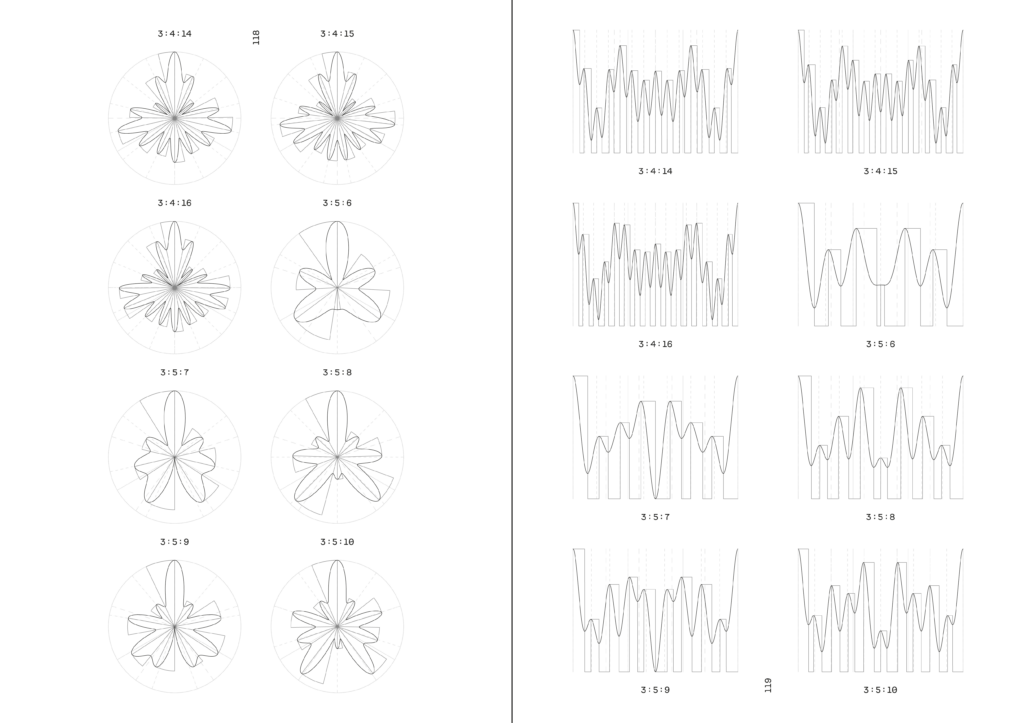
The book maps all prime ratios with two partial frequencies and all prime ratios with three partial frequencies up to 16. In addition, there are selected prime ratios with four partial frequencies up to 32. All figures also show the rediscretized representation. For each ratio there is a linear and a polar representation, which mathematically rotates time counterclockwise. The book is limited to in-phase ratios. The publications following this volume will be devoted in particular to phase shifts whose exact length is derived from a two-prime ratio.
Inspired by 19th-century field guides for species identification, this book offers not only the immediate visual appeal of the figures but also the opportunity to trace their evolution and search for unusual examples—for instance, those with fewer peaks than the frequency of the highest partial. Listening to the models via a website or plugin allows users to find existing applications and discover that some seemingly insignificant images sound surprisingly interesting. Ideally, this volume serves as an introduction to scientific or artistic work within an expanded rhythmic space, quickly developing a captivating and self-sustaining momentum.
¹ Why these points have been overlooked until now, even though the possibility of precise control of phase equality arose with the advent of computers, is not clear to me.
² Barad, Karen. 2007. Meeting the Universe Halfway : Quantum Physics and the Entanglement of Matter and Meaning. Durham, N.C. ; London: Duke University Press.
³ OEIS Foundation Inc. (2023), Entry A005728 and Entry A015616 in The On-Line Encyclopedia of Integer Sequences. https://oeis.org/A005728. https://oeis.org/A015616

funded by